

Dough management
Rheological and chemical aspects
Bulk fermentation, final proofing, acidification, proteolysis and other key factors
Author: Fabio Agliata
This article contains:
-
Introduction
-
Bulk fermentation, balling and final proofing
-
Fermentation, volume and pH
-
Acidification and gluten properties
-
Proteolysis and cold storage
-
Other dough-management variables
-
Summary table of dough-management variables
-
How to use the tables for dough management
-
References
Introduction
Bulk fermentation, final proofing, acidification, proteolysis and other key factors
Designing a baked product means connecting the desired crumb structure with the properties of the dough and the way it is handled. The aim is to reach stretching and baking with an appropriate balance of resistance, extensibility and gas-retention capacity.


Figure 1 Cross-sections of two tray-baked pizzas with different degrees of expansion and different air-cell structures.
Let us examine the factors that can produce different characteristics in these products
Bulk fermentation, dividing and final proofing
Definitions
1) Bulk fermentation (puntata): the period of resting and fermentation in bulk, from the end of mixing until the dough is divided.
2) Balling (staglio): the operation in which the dough is divided into portions of the required weight, which are then shaped into dough balls. When the whole batch is intended to form a single dough ball, this stage consists of reworking the dough through strengthening folds. These reduce the volume reached during bulk fermentation and create a tighter, more tenacious structure ready for final proofing.
3) Final proofing (appretto): the period of resting and fermentation after dividing and shaping, until stretching or the next planned operation.
From a biochemical perspective, the same main fermentation processes and enzymatic activities continue during bulk fermentation and final proofing. Even at a constant dough temperature, however, their rates can change as conditions inside the dough evolve.
Why, then, divide fermentation into two stages? The short answer is to manage the dough’s rheological properties more effectively, particularly the balance between tenacity and extensibility at the time of stretching. Between these stages, dividing and shaping alter the dough structure, gas distribution and stresses within the gluten network. Let us look at how this happens. [6, 7]
Consider a dough made from water, flour, baker’s yeast and salt, managed entirely at a constant room temperature.
From mixing until baking begins, throughout bulk fermentation and final proofing, the yeast ferments the sugars available in the dough. These include both sugars already present in the flour and those made available by enzymatic action on starch. [2] The main products of alcoholic fermentation are carbon dioxide and ethanol. Yeast metabolism also produces other compounds, including organic acids. [2]
Whereas ethanol does not contribute significantly to acidification, the organic acids produced can lower the dough’s pH. Succinic acid plays an important role in doughs made with baker’s yeast. Dissolved CO₂ can also contribute to acidity through the carbonic-acid system, but should not be regarded as the main cause of the decrease in pH. [2]
The extent and course of this decrease depend on the formulation and fermentation conditions, as well as the flour’s ability to buffer changes in pH. [2]
Fermentation continues throughout the different stages of dough handling. Their duration and distribution allow the baker to organise the work and obtain a dough suited to the time of use.
There is a direct correlation between the decrease in dough pH through fermentation and an increase in dough tenacity.
A decrease in pH can change the behaviour of gluten and, under certain conditions, increase dough tenacity. To understand how, we need to consider that proteins contain chemical groups whose electrical charge depends on pH.
As the environment becomes more acidic, some of these groups acquire protons, or H ions: this ⁺ process is called protonation. It changes the distribution of charges on the proteins and, consequently, the balance of interactions between protein chains and with water. [3]
Under certain conditions, the overall result is a dough that offers greater resistance to stretching and extends less before breaking: tenacity therefore increases and extensibility decreases. This behaviour has been observed experimentally, for example in doughs acidified with succinic acid, one of the acids produced by yeast during fermentation. [3]

Figure 3 Assumption: a dough made with flour, yeast water and salt kept at room temperature and managed in one single phase without reballing it. We have a lower pH lever with a volume that is too big to make a Neapolitan pizza.
Fermentation volume and pH
Baker’s yeast, Saccharomyces cerevisiae, uses fermentable sugars. It does not consume starch directly: flour enzymes help release smaller sugars that the yeast can use. [2]
The main products of metabolism
Alcoholic fermentation converts one molecule of glucose into two molecules of ethanol and two of CO₂. In the ideal reaction, 100 g of glucose produces approximately 51.1 g of ethanol and 48.9 g of CO₂. In real dough, some of the substrate supports cell growth and the production of other metabolites.
Organic acids are secondary products: among them, succinic acid can make an important contribution to the acidification of a straight dough. Ethanol is not the main cause of the fall in pH. Dissolved CO₂ also participates in acid–base equilibria. [2]
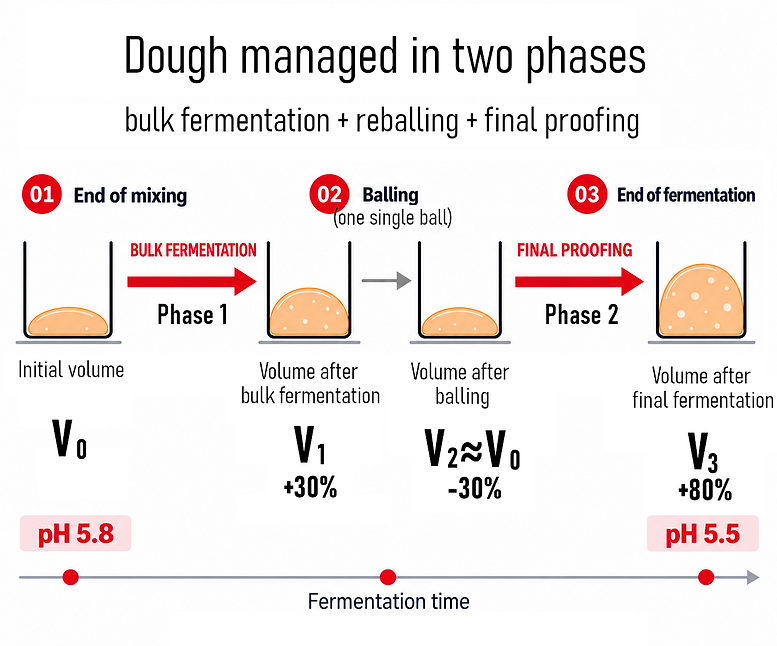
Figure 3 A typical two-stage dough process for classic Neapolitan pizza. It is possible to reach a suitable pH with the ideal volume for the intended product. Assumption: water, flour, yeast, salt at room temperature. The pH levels are hypotetical but plausible.
Fermentation, volume and pH
Baker’s yeast, Saccharomyces cerevisiae, uses fermentable sugars. It does not consume starch directly: flour enzymes help release smaller sugars that the yeast can use. [2]
The main products of metabolism
Alcoholic fermentation converts one molecule of glucose into two molecules of ethanol and two of CO₂. In the ideal reaction, 100 g of glucose produces approximately 51.1 g of ethanol and 48.9 g of CO₂. In real dough, some of the substrate supports cell growth and the production of other metabolites.
Organic acids are secondary products: among them, succinic acid can make an important contribution to the acidification of a straight dough. Ethanol is not the main cause of the fall in pH. Dissolved CO₂ also participates in acid–base equilibria. [2]

Figure 3 Dough handling can reduce volume without restoring pH to its initial value.
Volume depends on the CO₂ retained in the bubbles, dough deformability and temperature. pH depends on the acids, their dissociation and the flour’s buffering capacity, meaning its ability to resist changes in pH. [2, 8]
During fermentation, volume increase and acidification can progress together, but not in a fixed ratio. A doubling in volume does not correspond to a predetermined fall in pH. pH is also a logarithmic scale, not a direct measurement of total acids. [2, 8]
A practical correlation can only be established by repeatedly measuring the same recipe under the same conditions. Without this verification, volume indicates dough development, not a pH value.
Acidification and gluten properties
Acidification can help make dough more resistant to deformation and less extensible. This effect has been documented under specific conditions and combines with the effects of handling, temperature, hydration and proteolysis. [3]
A useful experimental finding
Jayaram and colleagues added succinic acid to doughs without yeast to isolate its effect. At 2.4 mmol per 100 g of flour, biaxial extension tests showed a 25–40% increase in strength and a 47–65% decrease in extensibility. Mixing stability decreased: the strengthening effect did not apply to every property. [3]
The higher dose exceeded the 1.6 mmol per 100 g of flour reported in the earlier fermentation study. The authors propose protein swelling and partial unfolding, which increase the opportunities for interaction, together with greater electrostatic repulsion. [3]

Figure 4 A purely illustrative alveogram, with no experimental values.
P is the maximum pressure measured in the test; L is the horizontal coordinate at rupture, used as an index of extensibility; W represents the deformation energy. The P/L ratio describes the balance between resistance and extension in the standardised test. It does not measure the size of the air cells in the crumb. [5]
There is no universal pH threshold that guarantees strengthening. The effects also depend on the acid used and cannot all be attributed to pH alone. The values on a flour specification sheet do not automatically describe the final fermented dough. [3, 5]

Proteolysis and cold storage
Proteolysis is the breakdown of proteins into smaller peptides and, sometimes, amino acids through the cleavage of peptide bonds. It is carried out by enzymes called proteases. [4]
An enzyme is a biological catalyst: it accelerates particular reactions without being consumed overall. Proteases cut proteins; they should not be confused with amylases, which act on starch.

Figure 5 A conceptual diagram of protein chains. The cuts are not cavities or air cells in the dough.
Moderate proteolysis can reduce resistance and promote extensibility. If excessive, it can lead to early rupture, gas loss and collapse. A weaker dough is not necessarily able to stretch further before breaking
The fridge
Proteolysis can continue slowly in the fridge. Fermentation and acidification, however, pause at 4 °C, with an important qualification: what matters is the temperature at the centre of the dough, which does not immediately match the air temperature. [9]
A substantial rest in the fridge can therefore lead to greater extensibility through proteolysis and a slower increase in tenacity as fermentation slows down and pauses. Manage the process and observe the result. [4, 9]
Other dough-management variables
1) Hydration: more water generally reduces consistency and makes deformation easier, but does not guarantee greater extensibility before rupture. The amount must be matched to the flour’s absorption capacity and the required structure. [5]
2) Salt: changes the interactions between proteins and water and influences microbial activity. Its role is not always minor; greater resistance after adding salt does not demonstrate that proteolysis has stopped. [10]
3) Fats: their quantity, type and time of addition change workability and product texture. Mixing and folding build and reorganise the structure; excessive work can damage it. Baking sets the structure and controls moisture and crispness.
4) Container shape and dimensions: influence the geometry of the dough and the directions in which it can expand during proofing. With the same amount of dough, a wide tray distributes it over a larger area, giving a lower initial thickness; once the dough reaches the walls of a narrow container, sideways expansion is restricted and a greater increase in height is encouraged. For focaccias that complete their proof in the tray, stretching produces a wide, relatively thin shape. During the rest, the dough relaxes, produces gas and increases in thickness. Once it occupies the entire available surface, further growth occurs mainly upwards: a lower final height than in a narrow tin therefore also depends on the amount of dough per unit area, rather than on the inhibition of vertical expansion. The structure retains a temporary memory of deformation because dough is viscoelastic. However, a narrow container supports growth mainly through the constraint imposed by its walls: once removed and stretched, the dough does not automatically retain a preference for vertical expansion. Transferring, folding, shaping and subsequent resting alter its structure again. Container shape therefore contributes to the product’s shape and height, but does not by itself determine whether the crumb will be fine or very open. [6, 7
5) Stretching: changes dough thickness, gas distribution and tension in the gluten network. Firm stretching or rolling, using even pressure or a rolling pin, expels some gas and reduces larger bubbles, encouraging a finer, more regular crumb. If further proofing follows, the remaining cells can expand again, allowing a soft product to develop even with small air cells. Gentle stretching, by contrast, preserves more of the bubbles that developed during fermentation and encourages a more open, irregular crumb. For Neapolitan pizza, pressure is applied mainly to the centre, while the rim is handled less to preserve its expansion; for very open-crumb tray pizza, the aim is to spread the dough without excessively compressing its internal structure. How relaxed the dough is when it is stretched also matters: if it strongly resists and springs back, forcing it can create uneven thickness or tears. Further resting can make spreading easier. Stretching therefore does more than give the product its shape: it determines how much of the existing gas-cell structure is preserved and prepares the dough for further proofing or baking. [1, 6, 7]]
6) Balling tension and final-proof duration: after division, shaping gathers the dough and tensions its surface. Tighter balling, performed without tearing the gluten network, initially produces a bettersupported dough ball that is more resistant to deformation. Gentler balling introduces less tension and can make stretching easier after a short rest. During final proofing, the stresses introduced by shaping gradually relax, while fermentation continues and the gas cells expand. Resting time must therefore also be matched to balling intensity: with other conditions unchanged, a tightly shaped dough ball generally needs longer to become easy to stretch. If final proofing is too short for the tension introduced, the dough tends to resist and spring back during stretching. If it is excessively prolonged relative to the dough’s structural capacity, the ball can spread too far, lose gas and become fragile. Temperature, flour, hydration and fermentation activity therefore matter alongside elapsed time. The aim is to reach stretching with a dough ball that is relaxed enough to spread, yet sufficiently structured to be handled without breaking. The resistance introduced by balling is an effect of handling and does not amount to an increase in the flour’s W value. [6, 7]
Summary table of dough-management variables
Use the following scale:
• 3 — High influence: can substantially change dough behaviour.
• 2 — Moderate influence: contributes to the outcome and can become decisive under certain conditions.
• 1 — Supporting influence: mainly used to fine-tune the result.
How to use the table
1. Define the result before assigning priorities to the variables.
Describe separately what you want from the dough and the finished product:
A fine, soft crumb, for example, requires many small cells capable of expanding, rather than simply a very resistant dough.
2. Adapt the priorities to the product.
The initial scores can change. For fine-crumb focaccia, stretching and final proofing deserve particular attention. For panettone, fats, mixing and acidity management become central. For pizza dough that springs back on the bench, the first variables to examine are temperature, balling tension and final proofing.
3. Also record the extent of each change.
For every trial, add a second score alongside the priority:
Always specify what you are increasing: hydration, temperature, duration, balling intensity or the pressure applied during stretching. For acidification, +1 means greater acidification and therefore generally a lower pH, not a higher pH. These scores must be accompanied by actual values: for example, hydration 65 → 68%, change +1. The classification of a change as slight or substantial must remain consistent across your trials.
4. Do not add up the scores to calculate final tenacity.
The variables interact: tight balling followed by a long final proof may leave a well-relaxed dough ball; the same balling with a short final proof may make it difficult to stretch. Time, temperature, acidification and proteolysis are also connected: adding them as independent effects would count parts of the same process more than once.
5. Change only a few variables and compare the prediction with the result.
6. Use the results to update the table.
After baking, record the effect as absent, slight or substantial, together with any unwanted consequences. As you repeat the trials, the scores become a useful description of your dough and your process, rather than a universal prediction.
References
Numbered citations identify the relevant sources. Notes A–F explain the scope of the evidence. Experimental sources do not automatically validate every product example or teaching score.
[1] Molino Grassi. Genovese focaccia using the straight-dough method. Professional recipe. Scope: stretching, bubble removal and final proofing; not a controlled study. https://www.molinograssi.it/recipe/
[2] Jayaram, V. B., Cuyvers, S., Lagrain, B., Verstrepen, K. J., Delcour, J. A. and Courtin, C. M. (2013). Mapping of Saccharomyces cerevisiae metabolites in fermenting wheat straight-dough reveals succinic acid as pHdetermining factor. Food Chemistry, 136, 301–308. Scope: yeast metabolites and straight-dough acidification. https://doi.org/10.1016/j.foodchem.2012.08.039
[3] Jayaram, V. B., Cuyvers, S., Verstrepen, K. J., Delcour, J. A. and Courtin, C. M. (2014). Succinic acid in levels produced by yeast (Saccharomyces cerevisiae) during fermentation strongly impacts wheat bread dough properties. Food Chemistry, 151, 421–428. Scope: effects of succinic acid on strength, extensibility and stability. https://doi.org/10.1016/j.foodchem.2013.11.025
[4] Functional Characterization of the Proteolytic System of Lactobacillus sanfranciscensis DSM 20451T during Growth in Sourdough (2005). Applied and Environmental Microbiology, 71, 6260–6266. Scope: proteolysis, microbial peptidases and the role of cereal proteinases in an acidic environment. https://doi.org/10.1128/AEM.71.10.6260-6266.2005
[5] Jødal, A.-S. S. and Larsen, K. L. (2021). Investigation of the relationships between the alveograph parameters. Scientific Reports, 11, 5349. Scope: definitions of P, L and W, interpretative limitations and the influence of hydration. https://doi.org/10.1038/s41598-021-84959-3
[6] Sandoval, A., Chaunier, L., Chiron, H., Della Valle, G. and Reguerre, A.-L. (2017). Cellular structure and rheological properties of shaped fermented wheat flour dough. Journal of Cereal Science, 73, 91–98. Scope: shaping, cellular structure and viscoelastic response. https://www.sciencedirect.com/science/article/pii/S0733521016305173
[7] Impact of resting time between mixing and shaping on the dough porosity and final cell distribution in sandwich bread. Journal of Food Engineering, 194, 15–23. Scope: resting, relaxation, porosity and cell distribution; an experimental sandwich-bread system. https://www.sciencedirect.com/science/article/pii/S0260877416302667
[8] Impact of gas formation kinetics on dough development and bread quality. Experimental study of gas production and retention and structural integrity. PubMed bibliographic record. https://pubmed.ncbi.nlm.nih.gov/28455072/
[9] Xie, D., Li, X., Sun, Y. and Ren, S. (2023). Effect of different producing methods on physicochemical and fermentation properties of refrigerated dough. Journal of Food Composition and Analysis, 119, 105268. Scope: doughs refrigerated at 4 °C for 24 hours, and their fermentation and structural performance. https://www.sciencedirect.com/science/article/pii/S0889157523001424
[10] A Comprehensive Study on the Influence of Sodium Chloride on the Technological Quality Parameters of Soft Wheat Dough (2020). Foods, 9(7), 952. Scope: effects of salt on the technological characteristics of wheat doughs. https://doi.org/10.3390/foods9070952